


Pet product OEM manufacturing from coated webbing to finished collars and leashes
Sep 20, 2026
Leave a message
A brand may begin with a collar, then add a matching leash, harness or accessory. On paper, these can look like separate products. In manufacturing, however, they often need to work together as one product family.
For private-label brands, wholesalers and distributors, this creates a different sourcing challenge. The goal is not simply to manufacture several products. It is to make sure the range looks consistent, works as intended and can be managed efficiently across different product types.
This is where product-line planning becomes important.

Think About the Range Before Developing Every Individual Product
A common approach is to develop products one at a time.
A buyer may first request a collar, then return later with a leash and eventually add a harness. This can work, but decisions made for the first product may influence the later products.
For example, a particular webbing appearance, hardware finish or brand treatment may become part of the visual identity of the range.
Planning the product family at an early stage gives the manufacturer a better understanding of what the brand is trying to build.
Instead of treating each request as an isolated order, the manufacturer can consider how the products are expected to relate to one another
Decide Which Elements Should Be Shared
Not every part of a product range needs to be identical.
In fact, making everything identical can create limitations because collars, leashes and harnesses have different structures and functions.
A better approach is to identify the elements that should remain consistent.
These may include:
Brand colors
Surface appearance
Webbing style
Hardware finish
Logo treatment
Packaging language
Overall visual direction
Other elements can then change according to the individual product.
This creates a recognizable product family without forcing every item into exactly the same construction.

Consider Material Consistency Across Products
Material decisions can have a wider effect when several products are being developed together.
A coated webbing used on a collar may also be suitable for a leash or another accessory, but the required construction may not necessarily be identical.
Different products can require different widths, lengths or assembly methods.
The important point for buyers is to distinguish between material identity and exact material specification.
A brand may want the same general coated-webbing appearance throughout its range while using different specifications for individual products.
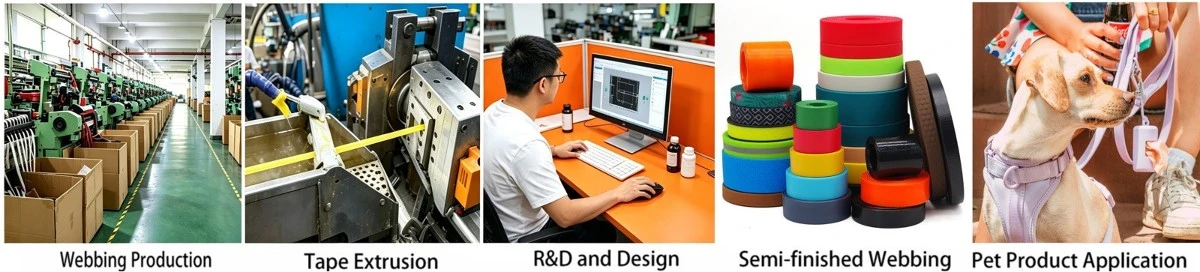
For a manufacturer that handles webbing production and finished pet-product manufacturing internally, this type of coordination can be discussed during product development rather than managed between separate suppliers.

Internal link: [PVC & TPU Coated Webbing]
Plan the Brand's Hardware Language
Hardware can become one of the strongest visual connections between products.
A collar, leash and harness may use different hardware because their structures are different. However, the finish, shape or general appearance can still be coordinated.
For example, a brand may want its products to use a consistent hardware finish even when the individual components are different.
This is worth considering when building a product range because changing hardware suppliers or finishes from one product to another can create visible differences.
The objective is not to use identical hardware everywhere. It is to establish a recognizable hardware direction that works across the range.
Build Around the Brand's Market, Not Only the Product
A product range should also reflect where and how the products will be sold.
A brand selling through specialty pet retailers may need a different product mix from an online private-label seller.
A distributor may prioritize a broader size range and practical packaging, while a brand launching a premium collection may place more emphasis on coordinated appearance and finishing details.
This means product development should start with the intended market.
Before expanding from one product into several, buyers should consider:
Which products will be sold together?
Which products are core items?
Which products are supporting items?
Which sizes or variants are actually required?
Will the products be sold individually or as a collection?
Does the packaging need to present them as one range?
These decisions can help prevent a product catalog from becoming unnecessarily complicated.
Avoid Creating Too Many Variants
A larger product range does not automatically create a stronger offering.
Every additional color, size, hardware option or packaging variation can increase the number of combinations that need to be managed.
For example, three products offered in several colors and sizes can quickly become a much larger production program than expected.
For B2B buyers, the practical question is therefore not simply:
How many products can we offer?
It is:
Which product variations are commercially useful?
Starting with a focused range can make purchasing, inventory planning and product management easier. Additional variants can then be introduced according to market demand.
Consider How the Products Will Be Manufactured Together
The manufacturing relationship between products is another reason to plan the range as a whole.
If a supplier can handle related processes internally, the buyer may be able to coordinate material development, product construction, branding and production through one manufacturing system.
For GH Material, this is particularly relevant because the company combines coated webbing production with finished pet-product manufacturing.
The same manufacturing system can support projects involving custom collars, leashes, harnesses and selected pet accessories.
This does not mean every product needs to use exactly the same materials or construction. Instead, it gives the buyer one place to coordinate the different parts of the product family.
Think About Repeat Orders From the Beginning
A product range should also be designed with future purchasing in mind.
The first order may be relatively small, but a successful product can later become a repeat item or expand into additional colors and related products.
Keeping the range organized makes future purchasing easier.
Buyers should be able to identify which products belong to the same collection, which specifications are shared and which details are unique to individual products.
This becomes especially useful when several products are reordered at different times.
A Product Family Is More Than Several Separate SKUs
For a private-label brand, collars, leashes, harnesses and accessories can become part of the same commercial identity.
The manufacturing challenge is therefore not only to produce each individual item correctly. It is to coordinate the elements that make the products look and feel like they belong to the same brand.
That requires a broader view of product development.
Instead of asking only whether a manufacturer can make one product, buyers can also consider whether the supplier can support the development of a connected product range.
GH Material supports custom pet-product projects covering dog collars, leashes, harnesses and selected accessories, with in-house coated webbing production supporting the finished-product manufacturing process.
If you are developing several related pet products for the same brand, you can send your product ideas, reference images or initial range plan to discuss the manufacturing options.
Internal link: [Pet Product OEM & ODM]
CTA: Request a Quote