


How To Choose PVC Webbing Width For Dog Collars And Leashes
Aug 28, 2026
Leave a message
Choosing the right PVC webbing width is an important step when developing dog collars and leashes. Width affects more than the appearance of the finished product. It can influence product strength, comfort, hardware compatibility, sewing performance and overall production cost.
For pet product manufacturers, wholesalers, distributors and private-label brands, selecting PVC coated webbing should therefore involve more than choosing a standard size. The ideal specification should be considered together with the dog's size, product application, webbing thickness, hardware dimensions and required tensile strength.

Why Does PVC Webbing Width Matter?
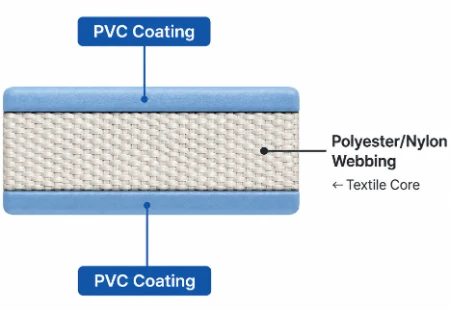
PVC coated webbing combines a textile core, usually polyester or nylon, with a PVC coating. The coating provides a smooth, waterproof and easy-to-clean surface, while the textile structure provides the main tensile performance.
Webbing width can affect several aspects of a finished dog collar or leash.
Strength and Load Distribution
A wider webbing can provide a larger contact area and distribute pulling forces over a greater surface. This can be particularly useful for medium and large dogs or heavy-duty leash designs.
However, wider webbing does not automatically mean a stronger finished product. Tensile strength also depends on the base material, weave construction, thickness, PVC coating and stitching method.
For this reason, buyers should evaluate the complete product specification rather than selecting webbing based on width alone.
Dog Comfort
The width of a collar also affects how pressure is distributed around the dog's neck.
A very narrow collar may concentrate pressure over a smaller area, while an excessively wide collar can add unnecessary weight or feel unsuitable for smaller dogs.
For product development, the width should therefore be matched to the intended dog size and collar design.
Hardware Compatibility
PVC webbing needs to work with the hardware used in the finished product.
Common components include:
Side-release buckles
D-rings
Tri-glide adjusters
Snap hooks
Sliders
Metal buckles
For example, a 20 mm webbing design will normally require hardware designed for approximately 20 mm webbing. A mismatch can make assembly difficult and may affect the appearance or performance of the finished product.
Product Appearance
Webbing width also contributes to the visual proportions of a collar or leash.
A narrow webbing may create a lightweight and minimal appearance, while wider webbing can give a product a more substantial and heavy-duty look.
For private-label brands, this can be an important part of product differentiation.
Common PVC Webbing Widths & Selection Guide for Dog Collars
There is no single width suitable for every dog collar. The appropriate size depends on the target dog, collar construction and product positioning. When selecting collar webbing, consider more than the dog's breed. Four important factors should be taken into account: Dog size + neck size + pulling strength + collar construction.
As a general starting‑point reference for manufacturers, the following width ranges and detailed explanations are provided:
| PVC Webbing Width | Typical Application | General Target | Detailed Guidance |
|---|---|---|---|
| 12 mm | Lightweight collars | Toy and very small dogs | 12‑15 mm narrow webbing works well for lightweight collars for small dogs and puppies. It creates a lightweight product with a smaller overall profile. However, the hardware and stitching should also be appropriately scaled to the webbing. |
| 15 mm | Small collars | Small dogs | The 15‑20 mm width range is commonly suitable for small‑to‑medium‑sized dog collars. It provides a balance between appearance, flexibility and product strength and can work well for everyday pet collar designs. |
| 20 mm | Standard collars | Small to medium / medium dogs | The 20‑25 mm wider webbing is often considered for medium‑sized and larger dogs. It provides a more substantial appearance and can be suitable for collars designed for stronger pulling forces or outdoor applications. |
| 25 mm | Heavy‑duty collars | Medium to large dogs | 25‑30 mm+ extra‑wide webbing can be considered for large‑dog, heavy‑duty or specialized collar designs. When using wider webbing, manufacturers should also check whether the buckle, D‑ring, adjuster and other hardware are properly matched to the increased width. |
| 30 mm+ | Extra‑wide collars | Large dogs and specialized products | Same guidance for heavy‑duty, high‑pull and custom‑purpose collars. Always confirm hardware compatibility. |
These dimensions should be treated as starting specifications rather than universal standards. Final selection should be confirmed through product sampling and testing.
How to Choose PVC Webbing Width for Dog Leashes
Dog leashes have different requirements from collars because the webbing is exposed to pulling forces and is also handled directly by the user.
When choosing leash webbing, consider:
Dog size
Expected pulling force
Leash length
Handle construction
Snap hook size
User hand comfort
Finished product weight
A practical starting range is:
| PVC Webbing Width | Typical Leash Application |
| 12–15 mm | Lightweight small-dog leashes |
| 15–20 mm | Everyday small and medium-dog leashes |
| 20–25 mm | Standard and large-dog leashes |
| 25 mm+ | Heavy-duty or specialized leashes |
For a standard OEM dog leash, 20 mm or 25 mm can be a useful starting point, but the final specification should depend on the required tensile strength and overall construction.

PVC Webbing Width vs. Thickness
One of the most common mistakes in pet product sourcing is evaluating webbing only by width.
For example, two 20 mm PVC coated webbings can have different performance if they have different thicknesses, textile cores or coating constructions.
When requesting a quotation or sample, buyers should specify:
Webbing width
Webbing thickness
Base material
PVC coating
Tensile strength
Surface finish
Color
A wider webbing with a lightweight construction may not perform better than a narrower webbing with a stronger textile structure.
Therefore, width and thickness should be evaluated together.
How PVC Webbing Width Affects Hardware Selection
Hardware compatibility should be confirmed before mass production.
For example:
20 mm webbing → 20 mm compatible buckle and adjuster
25 mm webbing → 25 mm compatible buckle and adjuster
The same principle applies to D-rings, sliders and other components.
For OEM projects, it is recommended to confirm the following before approving the production sample:
Actual webbing width
Webbing thickness
Inner hardware width
Hardware material
Stitching position
Hardware load performance
Finished-product tensile strength
This can help reduce assembly problems and prevent hardware mismatches during mass production.

What Should B2B Buyers Ask a PVC Webbing Supplier?
When sourcing PVC coated webbing for pet products, a width specification alone is not enough.
A complete inquiry can include:
Width: 15 / 20 / 25 / 30 mm
Thickness: Required finished thickness
Base material: Polyester or nylon
Color: Standard color or Pantone matching
Surface: Matte, glossy or customized finish
Tensile strength: Required performance
Application: Collar, leash, harness or other pet product
Logo: Heat-transfer or other branding requirements
Hardware: Required buckle, D-ring or snap hook size
MOQ: Trial and bulk order quantities
Samples: Material and finished-product samples
Packaging: Bulk or private-label packaging
Providing these specifications at the beginning of the sourcing process can make it easier for suppliers to recommend a suitable construction and prepare accurate samples.
Custom PVC Webbing for OEM Pet Products
For brands developing private-label dog collars and leashes, PVC coated webbing can be customized beyond width.
Depending on the supplier's capabilities, customization may include:
Custom webbing width
Custom thickness
Pantone color matching
Matte or glossy surface
Heat-transfer logos
Custom hardware
Custom collar and leash lengths
Private-label packaging
This allows brands to develop matching collar, leash and harness collections while maintaining consistent colors and materials across different products.

Final Thoughts
Choosing PVC webbing width for dog collars and leashes should be treated as a product-development decision rather than simply a size selection.
For smaller dogs, 12–15 mm can be a practical starting range. 15–20 mm is suitable for many standard products, while 20–25 mm can be considered for medium and larger dogs. Heavy-duty applications may require 25 mm or wider webbing.
However, width should always be evaluated together with thickness, base material, tensile strength, hardware compatibility, stitching and the intended application.
For B2B buyers, the best approach is to define the complete specification, request samples and verify the finished product before moving into mass production. This helps ensure that the selected PVC coated webbing meets both performance requirements and the visual standards of the brand
FAQs
Are you a factory or a trading company?
We are a professional manufacturer with 30 years of experience in the ribbon industry. We have integrated production facilities that combine a ribbon weaving factory, a dyeing and finishing factory, and a sewing factory, providing one-stop service from production to finished products.
What are your core strengths?
30 years of industry experience: Extensive expertise in webbing production and customization ensures consistent quality and on-time delivery; One-stop service: Integrating webbing, dyeing, cutting, and sewing to reduce intermediate steps and costs; Strict quality control: Comprehensive quality inspection from raw materials to finished products; Professional customization: Flexible OEM & ODM services to meet diverse customer needs.
Do you offer customized services?
Yes, we fully support OEM and ODM customization. You can customize materials (e.g., nylon, polyester), specifications (width, thickness, length), patterns, colors, logos, and additional features. If you don't have complete drawings, we can provide design references and start prototyping after your confirmation.
Can I get a sample to check the quality?
Stock Samples: We provide 1-3 meters of free stock samples, but the shipping cost is your responsibility. Customized Samples: If you require customized samples, please place a sample order or trial order. A sample fee is required, but it is refundable when your bulk order quantity meets our minimum order quantity (MOQ).
Can I mix multiple colors and sizes in one order?
Yes, we support mixing multiple colors and sizes in a single order, as long as each color/size meets the minimum order quantity requirement. Please provide details when placing your order, and we will arrange production accordingly.
Can you provide certification documents (such as a TC)?
Yes. For products certified by GRS, GOTS, FSC, or BCI, we can provide the corresponding TC to meet your import requirements.